
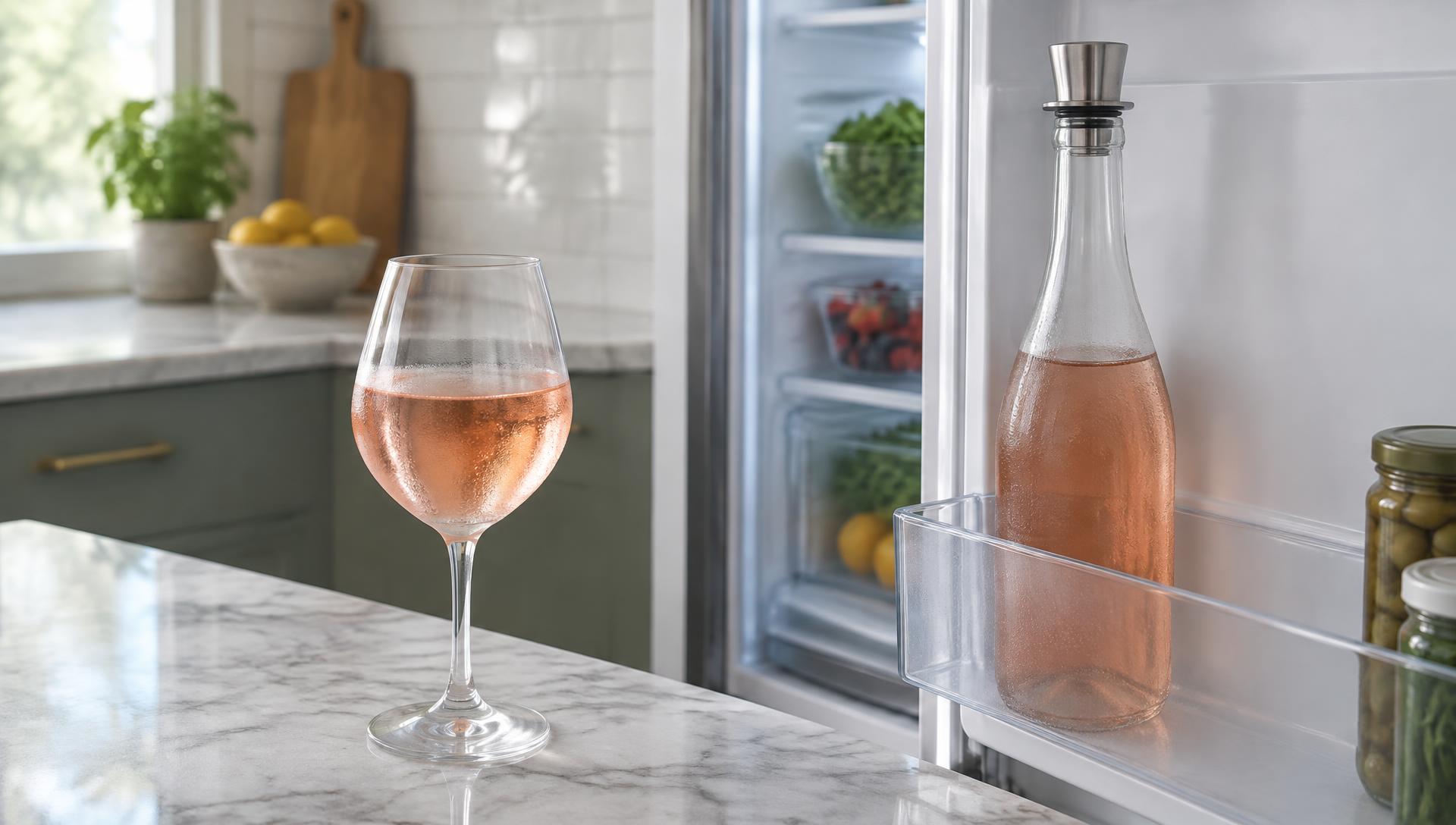
How long does rosé last after opening?
Many opened rosé wines remain enjoyable for around 2–4 days when resealed and refrigerated promptly. Some may remain acceptable a little longer, but freshness, fruit and aroma usually fade over time.
This is a general freshness guideline, not a safety or quality guarantee.
Rosé storage at a glance
- Opened bottle
- Reseal and refrigerate promptly.
- Typical freshness window
- Often around 2–4 days after opening.
- Unopened bottle
- Store in a cool, dark, stable environment and follow producer guidance.
- Heat
- Avoid prolonged heat exposure.
- Sunlight
- Avoid direct sunlight.
- Before serving again
- Check aroma, appearance and taste.
How long does opened rosé wine last?
For many dry rosés, expect approximately 2–4 days of good freshness when the bottle is resealed, refrigerated promptly and kept away from heat. This varies, and four days is not a universal expiry date.
It depends on:
- wine style
- oxygen exposure
- how full the bottle is
- storage temperature
- closure quality
- age of the wine
What happens after you open a bottle of rosé?
Once a bottle is opened, oxygen gets in. A little contact with air often makes little difference at first.
Over time, though, fruit can fade, aromas change, freshness decreases and flavours may become flatter. This gradual process is called oxidation.
Does rosé need to be refrigerated after opening?
Yes. Once opened, rosé should generally be resealed and refrigerated.
Cool temperatures slow the changes that cause wine to lose freshness. They do not stop them completely.
How to store rosé after opening
- Reseal the bottle.
- Put it in the refrigerator promptly.
- Keep it upright.
- Keep it away from heat and direct light.
- Taste before serving again.
Standing the bottle upright keeps less of the wine's surface in contact with the air inside than laying it down.
Can you put the cork back in rosé?
Yes. Replacing the original cork or using a clean wine stopper is better than leaving the bottle open.
If the bottle has a screwcap, simply close it securely. No expensive accessories are needed.
Do vacuum wine stoppers help rosé last longer?
Vacuum systems remove some of the air in the bottle and may help preserve freshness a little longer. They do not make opened wine last indefinitely. A good seal plus refrigeration remains the key practical approach.
Can you drink rosé a week after opening?
It may still be drinkable in some cases, but a week is beyond the best-freshness window for many rosé wines.
If it has stayed sealed and refrigerated, check its smell, appearance and flavour before deciding whether to serve it.
What about two weeks after opening?
For most standard still rosé, freshness is likely to have declined significantly by then. Even if it hasn't obviously spoiled, the wine may taste flat, oxidised or unpleasant. An ordinary opened bottle isn't worth saving for weeks.
Can you drink rosé that was left out overnight?
If the bottle stayed open, warm or in direct sun, its quality may have dropped quickly.
If it was resealed and left somewhere cool indoors, it may still be acceptable, although the fridge would have been better. Check how it smells and tastes before serving.
What happens if rosé is left in the sun?
Heat and direct sunlight can speed up deterioration and damage wine quality. Avoid leaving bottles in car interiors, on sunny terraces for long periods, on a deck in direct sun or on windowsills.
Serving outdoors? Keep bottles cold and shaded — see How to Serve Rosé Wine.
How can you tell if rosé wine has gone bad?
Aroma
- a vinegar-like smell
- a strongly oxidised aroma
- unpleasant stale notes
Taste
- flat
- sharply sour
- unpleasantly oxidised
- far less fresh than when opened
Appearance
- unexpected cloudiness
- unusual colour change
Sediment or a colour change alone does not always mean a wine is faulty, so use several signs together.
When in doubt, do not serve a bottle that smells or tastes clearly wrong.
Why can old rosé become darker?
Oxidation and age can gradually shift a rosé's colour. A fresh pink wine may become deeper, more orange-toned or brownish, depending on style and age. Colour alone should not be the only test.
Can rosé turn into vinegar?
Over time, wine exposed to oxygen and certain microorganisms can develop vinegar-like aromas. An opened bottle at home won't become proper cooking vinegar overnight, but a sharp, vinegary smell is a clear sign it is past its best.
How long does unopened rosé wine last?
There is no universal expiry date. How long a bottle keeps depends on:
- wine style
- vintage
- how it was made
- closure
- storage
- how the producer intends it to be drunk
Many rosés are made to be enjoyed relatively young, while their freshness is at its best. Some more structured rosés can age longer. The producer's guidance takes priority.
Does unopened rosé expire?
Wine does not usually carry a simple expiry date in the same way as perishable food, but its quality can evolve and eventually decline.
A wine may remain drinkable while no longer showing the freshness or character it was made to have.
Should rosé wine be aged?
Many rosés are made for relatively early enjoyment, though some more structured rosés can develop with age. Grape variety, production style and the producer's intention all matter, so not every rosé needs to be drunk immediately.
Does the vintage matter?
Yes. The vintage tells you the year the grapes were harvested. On its own, though, it can't tell you whether a bottle is still at its best — wine style, producer, storage and intended drinking window matter too.
How should unopened rosé be stored?
Keep bottles somewhere:
- cool
- at a stable temperature
- dark
- away from direct sunlight
- away from strong heat
For cork-sealed bottles kept for a long time, proper cellar conditions may matter more. For ordinary home storage, a cool cupboard away from the oven and windows works well.
Can unopened rosé stay in the fridge?
Short-term chilling before serving is normal. A kitchen fridge is not ideal for long-term wine storage, because it can be very cold, the air can be dry, and frequent opening adds vibration and temperature swings.
For ordinary short-term storage and getting bottles ready to serve, though, the fridge is practical.
Can rosé stay in the fridge for several days before opening?
Yes, generally, as preparation for serving. A few days in the fridge won't damage a bottle. For longer-term storage, follow the producer's guidance.
What temperature should rosé be stored at?
Storage and serving are different. For storage, wine generally prefers cool, stable conditions rather than cold ones.
For serving temperature, read our complete Rosé Wine Serving Temperature guide.
Can you freeze rosé wine?
Freezing wine is not recommended for normal storage. As wine freezes it expands, which can push out the closure, damage the bottle and change the wine's quality.
To chill a bottle quickly, use an ice-water bucket instead — see How to Serve Rosé Wine.
Storing opened rosé aboard a yacht
- Reseal promptly
- Return the bottle to refrigeration
- Keep it out of direct deck sunlight
- Avoid long exposure to warm outdoor air
More in Rosé wine for yachts.
What happens to opened bottles after an event?
Where appropriate, reseal opened bottles and refrigerate them promptly, keep unopened bottles in proper storage and follow the venue's policies. If many bottles remain, don't assume they can be returned. Supplier return policies vary.
Planning quantities to reduce leftovers? How many bottles do you need.
What should you do with leftover wedding wine?
Unopened bottles
Store them following normal wine-storage guidance: cool, dark and stable.
Opened bottles
Reseal and refrigerate, then enjoy within the usual freshness window.
Planning the wine? Wine for a wedding.
What usually happens after opening?
Day 0–1
Often closest to the original profile.
Day 2–3
Many rosés can remain fresh when refrigerated and resealed.
Day 4+
Freshness may begin to fall noticeably, depending on wine and storage.
Around one week
Many standard rosés will be well past peak freshness.
Illustrative only. Wine evolves differently depending on style and storage.
Is your opened rosé still fresh?
Likely still within a common freshness window.
Check aroma, appearance and taste before serving.
General guidance only — not a safety or quality guarantee.
Common mistakes that shorten rosé freshness
Leaving the bottle open
More oxygen exposure.
Leaving it on the kitchen counter
Warmer temperatures speed up change.
Direct sunlight
Heat and light can damage wine.
Leaving it on a hot terrace
Especially in summer.
Forgetting to reseal it
Easy to avoid.
Expecting the fridge to preserve it indefinitely
Cold slows change; it does not stop it.
Maison Cala
How should Maison Cala Rosé be stored?
For unopened Maison Cala Rosé, store the bottle in a cool, dark and stable environment away from direct heat and sunlight. Once opened, reseal it and keep it refrigerated, and check aroma and taste before serving again.
- Wine
- Maison Cala Rosé — French rosé
- Grape
- Grenache
- Vintage
- 2024
- Bottle size
- 75 cl
- Produced in
- Southern France
Keeping Maison Cala at its best.
Store Maison Cala Rosé away from unnecessary heat and light, chill it for service, and once opened, reseal and refrigerate promptly.
Frequently asked questions
- How long does rosé last after opening?
- Many opened rosés remain enjoyable for around 2–4 days when resealed and refrigerated promptly. Freshness then usually fades.
- How long does opened rosé last in the fridge?
- Often around 2–4 days, resealed and standing upright. Some may remain acceptable a little longer.
- Does rosé wine go bad?
- Yes, its quality declines over time, especially after opening. Oxygen and warmth make fruit and freshness fade.
- Does rosé need to be refrigerated after opening?
- Yes. Once opened, rosé should generally be resealed and refrigerated.
- Can you drink rosé after 3 days?
- Often, yes, if it was resealed and refrigerated. Check aroma and taste before serving.
- Can you drink rosé after 5 days?
- Sometimes, but freshness may have declined noticeably. Check aroma, appearance and taste first.
- Can you drink rosé after a week?
- It may still be drinkable in some cases, but a week is beyond the best-freshness window for many rosés.
- Can opened rosé last two weeks?
- For most standard still rosé, freshness is likely to have declined significantly by then, and the wine may taste flat or oxidised.
- Can you drink rosé left out overnight?
- If it was resealed and kept somewhere cool, it may still be acceptable. If it stayed open, warm or in the sun, quality may have dropped. Check it before serving.
- How do you know if rosé has gone bad?
- Look for a vinegar-like or stale smell, a flat or sharply sour taste, or unexpected cloudiness. When in doubt, do not serve a bottle that smells or tastes clearly wrong.
- Why does rosé turn darker after opening?
- Oxidation and age can gradually deepen a rosé's colour toward orange or brown. Colour alone should not be the only test.
- Can rosé turn into vinegar?
- Over time, wine exposed to oxygen and certain microorganisms can develop vinegar-like aromas, a sign it is past its best.
- How long does unopened rosé last?
- There is no universal expiry date. It depends on style, vintage, closure, storage and the producer's intention. Many rosés are made to be enjoyed relatively young.
- Does unopened rosé expire?
- Wine does not usually carry a simple expiry date like perishable food, but its quality can evolve and eventually decline.
- Should rosé be aged?
- Many rosés are made for relatively early enjoyment, though some more structured rosés can develop with age. Follow the producer's guidance.
- Should unopened rosé be refrigerated?
- Not necessarily for storage. A cool, dark, stable place suits unopened bottles; chilling in the fridge before serving is normal.
- Can you freeze rosé wine?
- It is not recommended. Freezing can push out the closure, damage the bottle and change the wine's quality.
- How should Maison Cala Rosé be stored?
- For unopened Maison Cala Rosé, store the bottle in a cool, dark and stable environment away from direct heat and sunlight. Once opened, reseal it and keep it refrigerated, and check aroma and taste before serving again.
Freshness starts with how you store it.
Once a bottle of rosé is opened, oxygen and temperature begin to change the wine. Resealing it promptly and keeping it refrigerated gives it the best chance of staying fresh for the next glass.
See the complete French Rosé Wine Guide for grapes, regions and styles.
Continue reading
- Grenache Rosé: A Guide to One of the Mediterranean’s Great Rosé Grapes
- How to Serve Rosé Wine
- Rosé Wine Food Pairing: What to Eat with Rosé
- How Many Bottles of Wine Do You Need for an Event?
- Rosé Wine for Yachts
- Rosé Wine for a French Riviera Wedding
- Wine for a Wedding
- The Mediterranean Apéritif
- Rosé Wine Serving Temperature
- French Rosé Wine: A Complete Guide
- Languedoc Rosé Wine: A Complete Guide
- Is Rosé Wine Dry or Sweet?
- How Is Rosé Wine Made?
- Rosé Wine with Seafood: What Pairs Best?
- What Does HVE Certification Mean for Wine?